The $2.8B Word That Means Three Different Things
The global proxy service market was valued at approximately $2.8 billion in 2023, growing at roughly 20% CAGR — driven almost entirely by the anti-bot arms race between scraping teams on one side and Cloudflare, Akamai, and PerimeterX on the other. Cloudflare alone sits in front of approximately 20% of all websites on the public internet. Any serious data-collection or multi-account operation is effectively negotiating with one anti-bot vendor’s ruleset at massive scale.
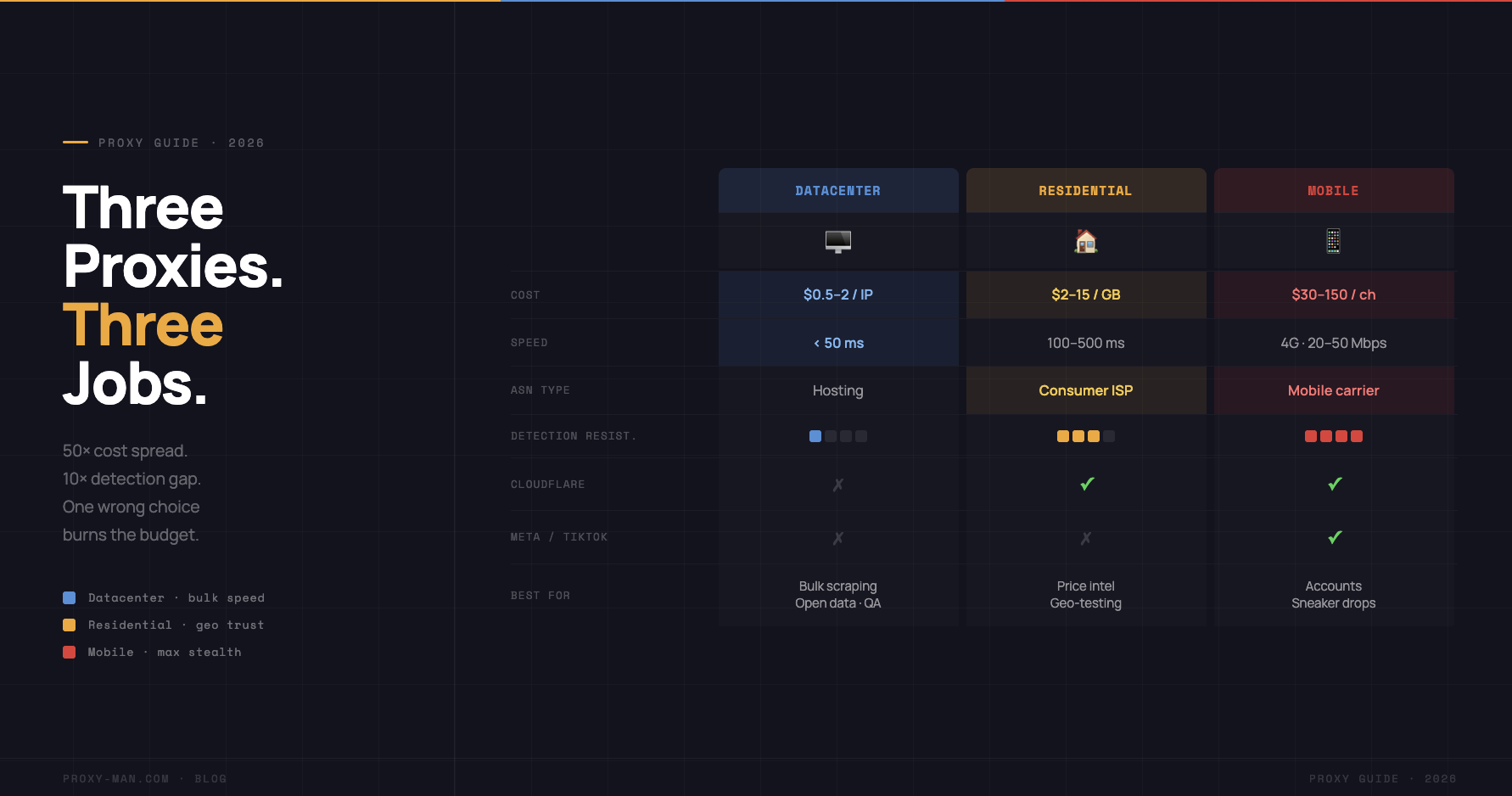
Underneath that single market number sit three products that share almost nothing except a protocol:
- Datacenter proxies — $0.50–$2 per IP/month, sub-50ms latency, unlimited bandwidth, ASN tagged as hosting.
- Residential proxies — $2–$15 per GB, 100–500ms latency, bandwidth is the constraint, ASN tagged as consumer ISP.
- Mobile proxies — $30–$150/month per channel or premium per-GB, 4G speeds, CGNAT-shared IPs, ASN tagged as mobile carrier.
Each type optimizes a different triangle: (cost per GB) × (detection resistance) × (speed). No provider can max all three — physics and economics forbid it. The rest of this piece is a practical taxonomy: what each type actually is, where it dominates, where it fails, and how to choose before touching a pricing page.
Datacenter Proxies: The 18-Wheeler. Cheap per Mile, Useless in a Back Alley
A datacenter proxy is an IP address hosted in a commercial data center — AWS, Hetzner, OVH, DigitalOcean — with an ASN that any anti-bot system recognizes as belonging to a hosting company, not a human being. This is not hidden information. MaxMind, IPinfo, and IP2Location tag these ranges continuously, and Cloudflare Bot Management, Akamai Bot Manager, and Kasada all maintain ASN reputation lists updated in near-real-time. An IP range flagged on one customer’s site propagates across the network within minutes.
Where datacenter proxies still dominate: bulk scraping of targets with no serious anti-bot — open government data portals, small e-commerce with no Cloudflare, Google Shopping feed collection at low volume, SERP scraping against non-FAANG engines, internal QA smoke tests, and any workload where speed and cost per GB matter more than ASN classification.
Where they fail immediately: any site running Cloudflare Enterprise, PerimeterX, Kasada, or Meta’s internal anti-bot system has the entire Hetzner/OVH/AWS/M247 ASN range effectively blocklisted. Open-source scraping benchmarks from communities like Apify and ScrapingBee show datacenter proxy success rates on Cloudflare-protected sites dropping below 10% as of 2024, versus 70–90%+ on unprotected targets.
The myth worth busting: “premium” datacenter proxies don’t escape this. Cloudflare does not care whether your hosting bill is $5 or $500 per month. It cares about the ASN. Nike’s Akamai configuration blocks the entire Hetzner/OVH/AWS range during sneaker drops, regardless of which “exclusive” datacenter provider sold you the IP.
Residential Proxies: The Rental Car with Local Plates. Slower, Pricier, but It Drives Through the Gated Neighborhood
A residential proxy uses an IP address that belongs to a real consumer ISP — Comcast, AT&T, Deutsche Telekom, Verizon — routed through an end-user device that has joined a peer-to-peer network, typically via an SDK embedded in a free app or service. To MaxMind, to Netflix, to Cloudflare’s bot scoring engine, this IP is indistinguishable from a normal home user — because it is a normal home IP.
Where residential proxies dominate: web scraping behind Cloudflare, multi-accounting on social platforms, ad verification, price intelligence on major marketplaces like Amazon and Walmart, geo-specific content testing, and streaming geo-checks. Success rates on Cloudflare-protected targets that reject datacenter IPs outright typically run 70–85% with a well-rotated residential pool.
The hidden cost trap that burns teams who do not calculate before buying: residential is billed per GB, and modern websites are heavy. The 2024 HTTP Archive Web Almanac puts the average page weight on top-1,000 e-commerce sites at approximately 2.7MB on desktop. A scraping job of 500,000 product pages requires over 1TB of residential traffic — at $10/GB, that is $10,000 in bandwidth before a single row lands in your dataset. Teams that start with residential because “it just works” and do not benchmark first routinely discover a four-figure bill in four hours.
The ethical conflict that the industry pretends does not exist: residential proxy pools are built on consent mechanisms buried in the terms of service of free apps. The 2019 controversy around Hola VPN and Luminati — now Bright Data — established publicly that millions of users were routing commercial traffic through their devices with no clear awareness. In 2023, the FTC settled with BIScience over exactly this model applied to free browser extensions. The sourcing question is not paranoia. It determines whether the user whose device you’re routing through consented in any meaningful sense. Ask every provider where their IPs come from before you sign a contract.
Mobile Proxies: The Diplomat’s Car. You Can’t Stop It at Any Checkpoint
A mobile proxy uses an IP address assigned by a mobile carrier to a 4G/LTE device — T-Mobile, AT&T Mobility, Verizon Wireless. What makes these IPs structurally different from every other proxy type is CGNAT: Carrier-Grade NAT. Mobile carriers share a single public IPv4 address among hundreds to thousands of concurrent subscribers. RFC 6598 reserves the 100.64.0.0/10 range specifically for this shared-address infrastructure.
The practical consequence: a platform that aggressively bans a mobile IP bans a neighborhood’s worth of legitimate users simultaneously. Meta, TikTok, Google, and Instagram are all aware of this asymmetry — their abuse-detection systems avoid hard blocks on mobile carrier ASNs because the collateral damage is too high. This structural immunity is why mobile proxies carry the highest trust score across every major anti-bot system.
Where mobile proxies dominate: high-value, high-risk account operations — ad agency Meta Business Manager at scale, TikTok Shop, Instagram multi-account client work, sneaker drops on mobile-first retailers, account warmup sequences, and any platform where a residential IP still gets flagged due to behavioral profiling.
Economics: $30–$150/month per dedicated channel, or premium per-GB pricing. This is not markup — it is the cost floor set by real SIM cards, real 4G hardware, and real carrier contracts. There is no software shortcut that produces a genuine mobile ASN.
The myth worth busting: mobile proxies are not slow. Modern 4G delivers 20–50Mbps, which is faster than many cheap residential setups. The speed constraint is latency variability from the radio layer, not throughput.
The uncomfortable supply-chain issue: SIM farms in low-cost jurisdictions are regularly marketed as “US mobile” or “EU mobile” proxies. The ASN fingerprint reveals the carrier’s actual country of registration. Verify the carrier’s ASN against a public BGP toolkit before committing to a mobile provider — a $40/month “US mobile” proxy routing through a Southeast Asian carrier does not give you a US mobile IP score.
The Cost/Risk Matrix: A One-Page Decision Framework
The decision depends on two variables: the anti-bot sophistication of your target, and your required volume. Map your workload against both axes before touching a pricing page.
| Target anti-bot tier | Low volume (<100K req/day) | Medium volume (100K–10M) | High volume (>10M) |
|---|---|---|---|
| None / minimal (open data, small sites) | Datacenter — rotating | Datacenter — rotating | Datacenter — bulk pool |
| Cloudflare Free / basic WAF | Residential — rotating | Residential — rotating | Residential + cost audit first |
| Cloudflare Enterprise / Akamai / PerimeterX | Residential — sticky sessions | Residential — sticky + behavioral delay | Residential + engineering review |
| Meta / TikTok / Google / Instagram | Mobile — sticky | Mobile — dedicated channel | Mobile — dedicated + account warmup |
The counterintuitive math on cost per successful request — which is the only number that actually matters:
Scenario: you need 1 million completed product pages from an Amazon category. Average page weight: 3MB. You are comparing a datacenter proxy at $1/GB versus a residential proxy at $10/GB.
- Datacenter at 8% success rate on this target: 12.5M attempts needed to land 1M completed pages. At 3MB per attempt: ~37.5TB of traffic. At $1/GB: $37,500 — plus engineering time for retries.
- Residential at 80% success rate: 1.25M attempts. At 3MB per attempt: ~3.75TB. At $10/GB: $37,500 — and you finish the job in a fraction of the time.
In this example the cost is the same — but the residential job completes. The datacenter job generates 11.5 million failed requests, burns engineering hours on retry logic, and likely triggers progressive rate limiting that degrades success rate further over time. The Google SRE book describes this class of error precisely: optimizing for the cheapest attempt is a local maximum that produces a globally terrible system.
The right reframe is not “which proxy is cheaper.” It is “which proxy is cheaper per completed row in the final dataset.”
The Mistake Nobody Wants to Admit: Buying from Three Providers When You Need One
The operational default for any team that has grown past basic scraping is three separate vendor relationships: one datacenter provider for bulk, one residential provider for Cloudflare targets, one mobile provider for account work. This arrangement is not a sign of sophistication. It is a sign that the tooling market has not caught up to how teams actually work.
The operational tax of three vendors: three dashboards, three invoicing cycles, three API schemas to maintain in your codebase, three support queues, three prepaid balances sitting idle when one job type is quiet. When a provider gets blocked or goes down — and they do — you are migrating under time pressure with a live workload.
The natural next step in this market is consolidation: one balance, one API, one support channel, the ability to switch proxy type as the job demands without switching vendors or rewriting integration code. That is the architecture PROXY-MAN is built around — datacenter, residential, and mobile under one dashboard, REST API and Telegram bot, HTTP(S)/SOCKS5, sticky and rotating sessions, and — because it sits inside the SMS-MAN ecosystem — the same balance as virtual phone numbers for teams that need both proxy and SMS verification in the same workflow.
This is not a model for everyone. It is specifically useful for teams that have already lived through at least one of the failure modes described in this piece: the surprise bandwidth bill, the sneaker drop that failed on every datacenter IP, the agency meeting three weeks before 80 accounts need to go live. Those teams already know they need all three proxy classes. The question is whether they want three vendors or one.
The proxy infrastructure market is currently where CDN was in 2012: fragmented specialist vendors, buyer personas still maturing, consolidation 10–15 years behind what Cloudflare eventually did for the CDN/WAF/bot management stack. The teams that consolidate early carry less operational overhead and smaller stale-balance write-offs at year end.
A 15-Minute Self-Audit Before You Renew Any Proxy Contract
Answer these seven questions about your actual workload before you open a pricing page. Forward this list to your team. The answers determine the proxy class — not the provider’s marketing.
- 1. What is the anti-bot tier of your primary target?
- Check whether the target runs Cloudflare, Akamai, PerimeterX, or Kasada. A quick
curl -Ion the domain and a look at response headers will tell you in 30 seconds. If it’s Cloudflare Enterprise or Meta/Google, datacenter proxies will not complete the job regardless of price. - 2. What is your realistic monthly GB volume at 2.5MB average page weight?
- Multiply your target request count by your average page weight. If the answer is in the terabytes, run the cost-per-successful-request math from Section 5 before committing to residential. A bandwidth estimate that feels fine at $1/GB becomes a different conversation at $10/GB.
- 3. What is your tolerance for IP rotation within a session?
- Rotating proxies are cheaper and sufficient for stateless scraping. Sticky sessions — same IP for the duration of a session — are mandatory for anything that involves login, cart, or multi-step flows. Confirm the provider offers sticky sessions at the tier you need before signing.
- 4. Do you need geo-targeting at country, state, or city precision — and can you verify the provider’s claims?
- Country-level geo is standard. City-level geo on residential or mobile is a premium feature and often overpromised. Verify claimed geo with an independent IP lookup tool (ipinfo.io, BGP toolkit) on a sample of IPs before committing to a contract that depends on precision geo.
- 5. What is your cost per successful outcome, not per attempt?
- Run the math in Section 5 against your specific success rate assumptions. If you do not know your current success rate by proxy class and target, your current proxy spend is probably wrong.
- 6. Do you need API integration for CI/CD, or is a dashboard enough?
- If your proxy usage is baked into automated pipelines, an API with documented authentication and session management is non-negotiable. A dashboard-only provider is a manual dependency in an automated workflow — a failure point at 3 AM.
- 7. If this provider gets breached, delisted, or shuts down, what is your migration cost?
- This is the quietly devastating question. If the answer is “significant re-engineering and days of downtime,” you are carrying vendor-concentration risk you may not have priced. The answer tells you whether a specialist provider or a platform vendor is the lower-risk choice for your workload.
Question 7 is the one most teams skip. It is also the one that most reliably predicts whether a proxy relationship becomes a liability during a live incident.